Analog vs. Digital Signals in Two-Way Radio: What You Need to Know
Nobody does communication better. But knowing why starts with understanding what's happening inside the radio in your hand.
Whether you're running a construction crew, coordinating a warehouse, or keeping emergency responders connected — the choice between analog and digital radio isn't just a technical footnote. It's a real decision that shapes how well your team communicates when it matters most. Let's make it simple.
How Voice Becomes a Signal (And Back Again)
Every two-way radio conversation starts the same way: you talk, the radio turns your voice into something that can fly through the air, and someone on the other end hears it. Where analog and digital part ways is in how they make that happen.
Analog: Think of a River
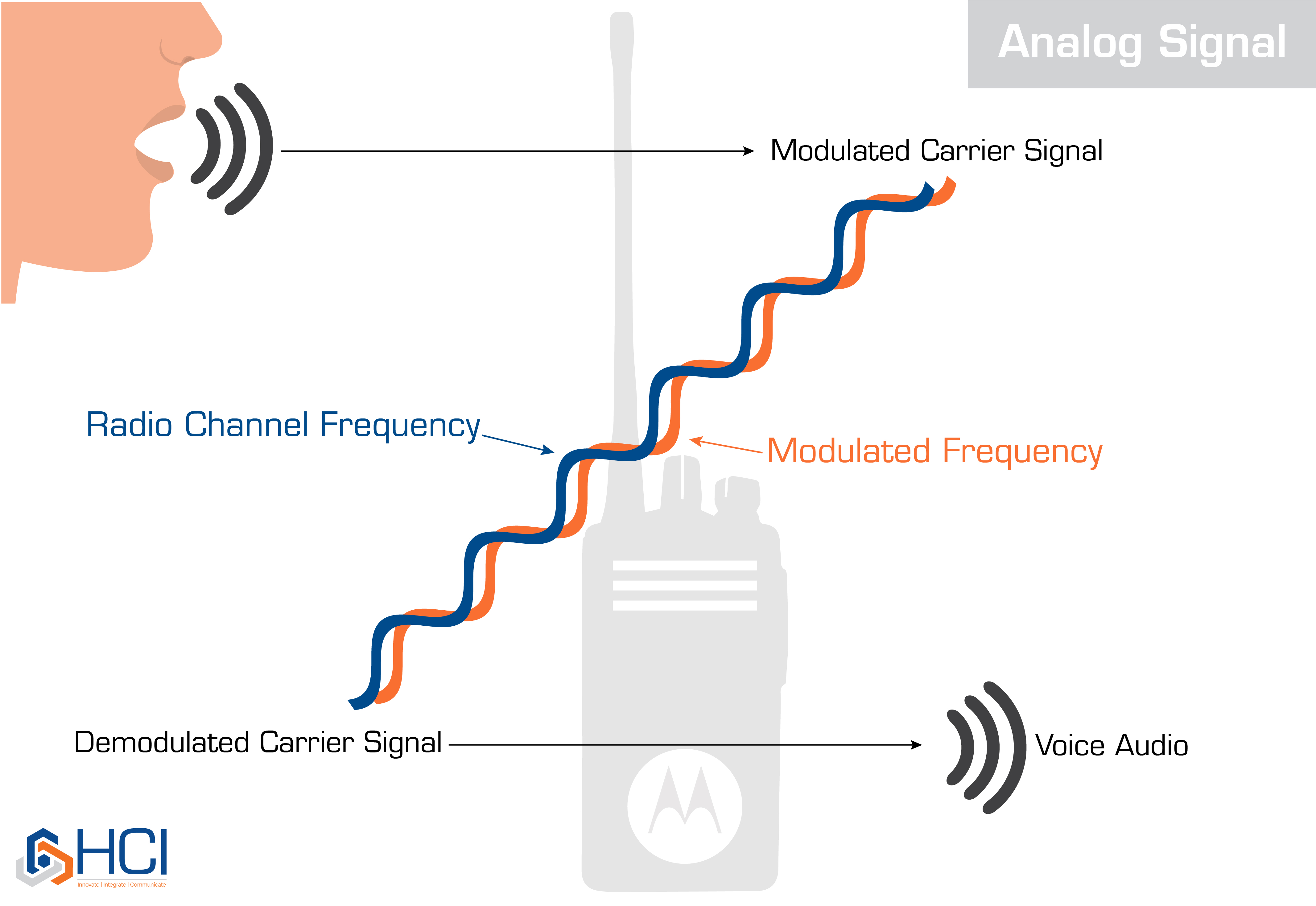
Imagine your voice as water flowing into a river. Analog radio works the same way — your voice directly shapes the radio wave in real time. When you speak louder, the wave changes. When you pause, it calms. The signal is a continuous, flowing imitation of your voice.
Here's the simple version of what happens:
- You speak → your microphone turns your voice into an electrical signal
- That signal rides along a carrier radio wave (like a surfer on a wave)
- The wave travels through the air to the other radio
- The receiving radio reads the wave and plays back your voice
The result? Near-instant audio (we're talking milliseconds), simple and affordable hardware, and a system that fades gracefully. Even in weak signal areas, you can still make out most of what's being said. It's like an AM radio station breaking up in the mountains — you catch enough to understand.
Digital: Think of a Text Message
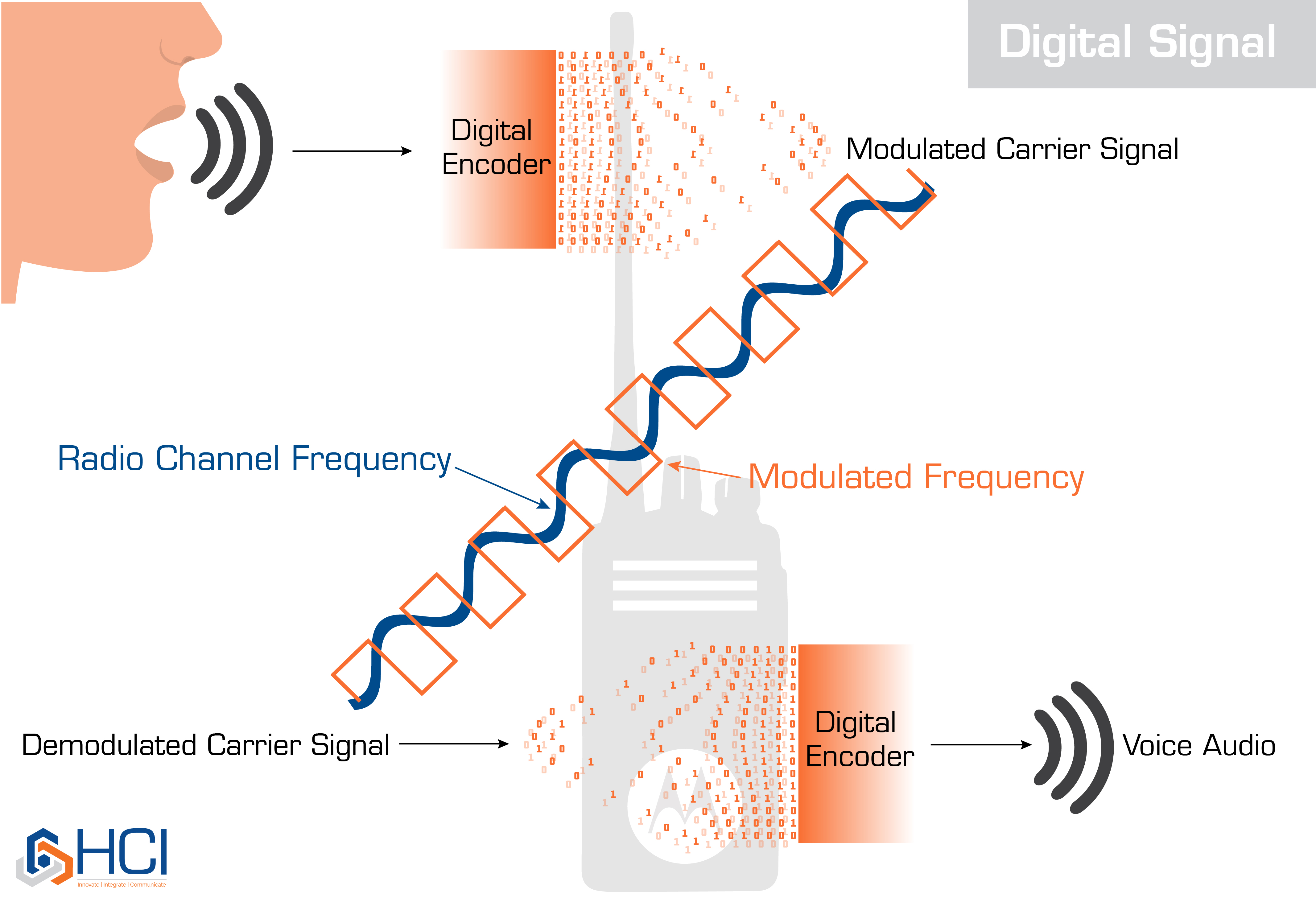
Digital radio takes a different approach. Instead of sending a flowing wave of your voice, it converts your voice into a stream of 1s and 0s — basically turning speech into data, like a text message — before sending it.
Here's what that looks like:
- You speak → a voice encoder compresses your audio into a data stream (think of it like zipping a file)
- Error-correction bits are added, like including a backup copy of key words in case some get garbled in transit
- The data is transmitted digitally over the air
- The receiving radio reassembles and decodes the data back into your voice
The payoff? Cleaner, more consistent audio at range. Plus built-in features like encryption, GPS location sharing, text messaging, and the ability to run two separate conversations on one channel at the same time.
💡 Analog vs. Digital in plain English:
Analog is like a live performance — raw, real-time, and you hear everything including the background noise.
Digital is like a studio recording — processed, polished, and consistent, but if the file gets corrupted, there's no in-between. It either plays perfectly or it doesn't play at all.
Head-to-Head: Analog vs. Digital
Here's how they stack up across the things that matter most in real-world use:
| Feature | Analog (FM) | Digital (DMR, P25, etc.) |
| Audio Quality | Strong when nearby; gets fuzzy at distance (like a radio station breaking up in the mountains) | Crystal-clear at range — until the signal drops. Then it cuts out completely |
| Noise Resistance | Fades gracefully — you still catch most words even in noisy areas | Error-correction fights through interference; extends range 20–30% in noisy environments |
| Speed (Latency) | Near-instant (~10–20 ms) — feels like a live conversation | Slight processing delay (~100–300 ms) — barely noticeable in normal use |
| Spectrum Efficiency | One conversation per channel | Two conversations on one channel (like a two-lane road vs. one-lane) |
| Features | Voice only — simple and reliable | Voice + encryption, GPS, text messaging, group calls |
| Weak Signal Behavior | Degrades slowly — you still hear something | "Cliff effect" — goes from clear to dead silence with no warning |
| Setup & Cost | Simpler hardware, lower upfront cost | More advanced — but future-proof investment |
★ Real-world insight: In noisy environments like warehouses, job sites, and busy streets, digital systems can extend effective radio range by 20–30%. That's the difference between a clear message and a missed one.
So... Which One Do You Actually Need?
Go Analog When:
- You need simple, affordable, easy-to-maintain radios
- Your team works in areas where some signal is always better than none — even if it's scratchy
- You already have analog infrastructure and aren't ready to upgrade
- Speed matters — every millisecond counts in your operation
Go Digital When:
- You need consistent, clear audio across longer distances
- Security is a priority (encryption keeps conversations private)
- You want more from your radios: GPS tracking, text messaging, status updates
- You're managing a large team and want two conversations on one channel
- You're building for the future and want technology that grows with you
🔄 Running both? You're not alone.
Many organizations today run hybrid systems — analog and digital side by side during the transition. Think of it like upgrading half your fleet to electric vehicles while the other half still runs on gas. It works, and it's often the smartest path forward. We help our customers navigate exactly this every day.
Where Each Technology Lives Today
Analog still has a strong foothold in amateur (ham) radio, smaller construction and event operations, and legacy public safety systems making the switch to digital over time.
Digital powers modern deployments across industries. A few of the most common standards you'll hear about:
- DMR (Digital Mobile Radio) — The commercial and industrial workhorse, widely used and cost-efficient
- P25 (Project 25) — The North American public safety standard, with strong encryption and interoperability between agencies
- TETRA — The go-to across Europe and Asia for transit, utilities, and government
- NXDN — A narrowband solution built for utilities and railroad environments
What's Coming Next
The industry is moving fast. Software-defined radios (SDRs) are making it possible to run multiple protocols on a single device — like a smartphone that can switch networks on the fly. 5G and LTE-based push-to-talk systems are extending digital radio reach into broadband networks. And AI-powered noise suppression is raising the bar on audio quality across the board.
That said, traditional narrowband digital radio isn't going anywhere. In remote areas, underground environments, or anywhere cellular fails, it remains the most reliable lifeline. Some things can't be replaced by an app.
The Bottom Line
Analog offers proven simplicity, However, digital delivers performance, features, and future-readiness making this the preferred option over 90% of the time. This all depends on your team, your environment, and what you need your radios to actually do.
The good news? You don't have to figure it out alone.
Ready to figure out what's right for your team? Let's talk.
NEXT STEP
Let's Get Your Team Connected.
As a telecommunications consultant, HCI has been solving communication challenges for businesses for over 30 years. We'll assess your environment, identify your gaps, and recommend the right solution — no guesswork, no oversell. As one of the top trusted two-way radio dealers in North America, we've seen every environment imaginable. We know the technology, and we know what works.
Contact HCI today for a free consultation or to gain further insight into digital vs analog radios.

HCI is the leading Motorola Solutions Channel Partner in Houston , Texas. We have been serving our clients for over 40 years.
Texas Security License: B24122601
Navigation
Popular Links
Contacts
Locations:
HCI
1105 Industrial Blvd.
Sugar Land, TX 77478
281-491-1616
HCI Dallas (Formerly Blair Communications, Inc.)
11407 Goodnight Lane
Dallas, TX 75229
972-247-4901
E-mail: Contact Us

