Does My Building Need ERCES?
If you've never heard the term ERCES until recently, you're not alone. It's one of those systems that sits quietly in the background of fire code compliance until someone asks about it during a permit review, an insurance audit, or a fire marshal's visit. And once you hear the term, the natural next question is simple: does this apply to my building?
The honest answer is that a lot of building owners in Texas don't actually know. Not because they haven't done their homework, but because the answer depends on a mix of factors that aren't always obvious just by looking at a building from the outside. That's what we want to walk through here: how to think about whether your building might need one, and what to do if you're still not sure after reading this.
Quick refresher: what is an ERCES?
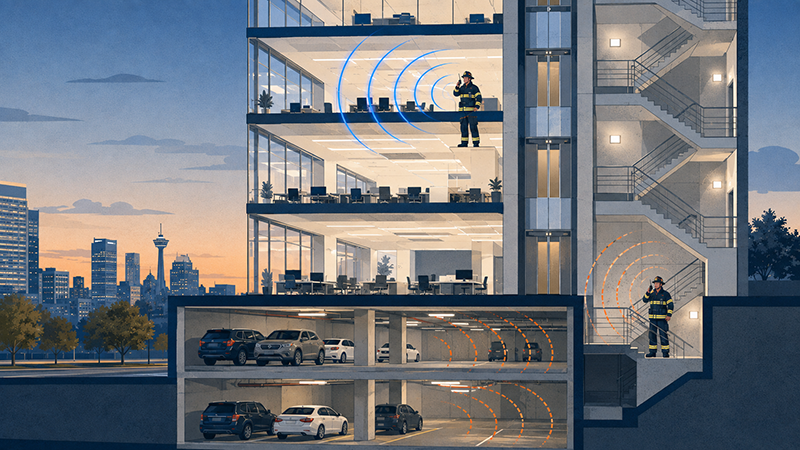
ERCES stands for Emergency Responder Communication Enhancement System. Think of it as a signal booster system built specifically for firefighters and police radios, similar in concept to how your cell phone carrier might install a small signal booster in a building with bad reception. Except instead of helping you make a phone call, it's making sure a firefighter on the 12th floor or in a parking garage two levels underground can talk to their team and call for help if something goes wrong.
Some fire codes use a slightly different name, "ERRCS" (Emergency Responder Radio Coverage System), but they're describing the same thing. In the Houston area, the fire code is based on the International Fire Code, and locally amended versions (including Harris County's amendments) are what your building would actually be measured against.
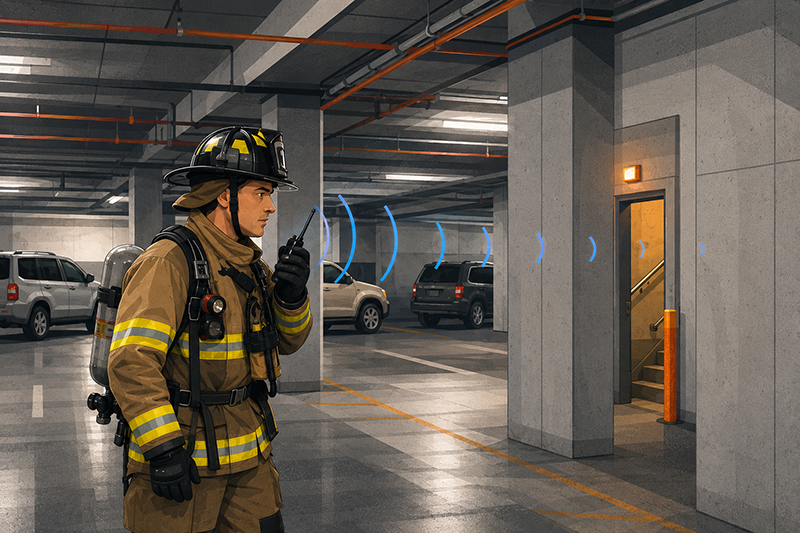
Why does this exist at all? Radios don't work the same way indoors as they do outdoors. Concrete, steel, low-emissivity glass, and even the sheer size of a building can all interfere with radio signals the same way a thick wall interferes with your home WiFi. The technical term for this is signal attenuation, but really it just means the signal gets weaker the more stuff it has to pass through. In a small wood-frame office, this usually isn't a big deal. In a large concrete high-rise, an underground parking structure, or a building with a below-grade level, it can be a serious problem.
What actually triggers the requirement
Here's where things get building-specific, and where a lot of the uncertainty comes from. Code officials generally look at a combination of the following:
Size and height. Larger buildings and high-rises are far more likely to trigger a requirement, simply because there's more material for a signal to travel through and more distance for it to cover.
Underground levels. Basements and underground parking are a classic problem area. Radio signal has to travel through soil and concrete to reach street level, and that's a much harder path than a signal traveling through open air.
Construction materials. Buildings built with a lot of steel reinforcement, concrete, or metal-backed insulation tend to block radio signal more than older buildings built with wood or lighter materials. This means two buildings the exact same size can have very different radio coverage depending on what they're made of.
Building age and renovation history. This one surprises a lot of owners. A building that was fine 15 years ago may not be fine today, either because the surrounding public safety radio system has changed, or because renovations added new materials (metal studs, insulated glass, additional floors) that changed how signal moves through the space. Many jurisdictions also apply the requirement to existing buildings when they go through a significant renovation, not just new construction.
Occupancy type. Hospitals, schools, high-occupancy assembly buildings, and similar structures often get extra scrutiny because more people (and more risk) are involved if responders can't communicate.
None of these factors on their own guarantees a problem. It's the combination that matters, which is exactly why guessing based on one or two of them (like "my building isn't that tall" or "it's not brand new") isn't a reliable way to know where you stand.
How would you actually know, without already having tested?
This is the part most owners get stuck on. You can't see radio signal. You can't smell it or feel it the way you'd notice a leaky roof or a flickering light. A building can look completely fine, pass every visual inspection, and still have serious dead spots, areas where a responder's radio simply won't transmit or receive a usable signal.
Some signs that are worth paying attention to:
Your building was constructed or renovated in the last several years and used a lot of concrete, steel, or energy-efficient (metal-coated) glass.
You have any underground level, even a single parking floor.
Your building is taller than a typical three or four story structure.
You've never had a fire marshal or AHJ (Authority Having Jurisdiction, meaning whichever local fire code official has authority over your building) formally ask about radio coverage, but you also haven't confirmed the opposite either.
You've completed permits for renovations recently and radio coverage never came up in the conversation.
If any of these sound familiar, that's not a reason to panic. It's a reason to get a real answer instead of an assumption.
Why waiting or guessing is a genuine risk
We want to be straightforward here, not alarmist. But there are two real consequences worth understanding.
The first is life safety, plain and simple. If firefighters or police enter your building during an emergency and their radios don't work reliably, they lose the ability to coordinate, call for backup, or report a change in conditions. This isn't a hypothetical inconvenience. It's the exact scenario ERCES requirements were written to prevent.
The second is compliance and liability. Fire code officials can require a signal test, called an RF grid test (more on that in a second), at various points: new construction, certificate of occupancy, renovation permits, or even a routine inspection. If your building fails that test and doesn't have a system in place, you're often looking at delayed permits, delayed occupancy, or required retrofit work under time pressure. That's a much harder and more expensive position to be in than knowing ahead of time and planning accordingly.
The uncomfortable truth is that "we've never had an issue" and "our building doesn't need this" are two different statements. The first just means nobody has tested yet.
The one step that actually answers the question
Everything above is meant to help you reason through the likelihood, but reasoning only gets you so far. The only way to know for certain whether your building has a radio coverage problem is to test the actual signal strength throughout the building. That's what an RF grid test does.
Here's the simple version: technicians walk the building in a grid pattern, floor by floor, measuring radio signal strength at set intervals. It's similar to how you might walk through a house with a WiFi signal checker to find the dead zones, except this is measuring public safety radio frequencies against the specific strength requirements your local fire code sets. The result is a clear, documented picture of where your building stands: which floors and areas meet the requirement, and which ones don't.
No guessing, no assumptions based on building age or square footage, just a direct measurement of what a firefighter's radio would actually experience inside your building today.
Where to go from here
If you've read this far and you're still not sure whether your building needs an ERCES, that uncertainty is actually the most useful signal you have right now. It means it's time to stop estimating and start measuring.
At HCI, we perform RF grid tests for building owners and facility managers across Texas who want a definitive, documented answer instead of a guess. There's no obligation attached to finding out. If your building passes, you'll have that documentation on hand for your next inspection or renovation permit. If it doesn't, you'll know exactly where the gaps are and what your options look like.
Reach out to schedule an RF grid test for your building. It's the most direct way to trade uncertainty for a clear answer.
About HCI
HCI partners with building owners, developers, and property managers as consultants and integrators to design, deploy, and maintain ERCES and commercial DAS solutions. We work with our customers to solve their communications goals—not to sell them equipment they don't need.
Innovate | Integrate | Communicate

HCI is the leading Motorola Solutions Channel Partner in Houston , Texas. We have been serving our clients for over 40 years.
Texas Security License: B24122601
Navigation
Popular Links
Contacts
Locations:
HCI
1105 Industrial Blvd.
Sugar Land, TX 77478
281-491-1616
HCI Dallas (Formerly Blair Communications, Inc.)
11407 Goodnight Lane
Dallas, TX 75229
972-247-4901
E-mail: Contact Us

